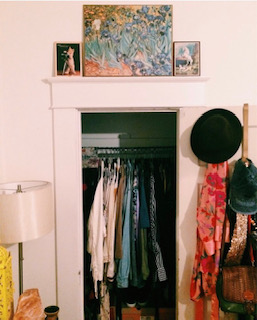
A little over half a year ago, I was diagnosed with obsessive compulsive disorder (OCD). As I have learned more about this disorder, I have come to realize that the symptoms have actually been present my entire life. For instance, when it comes to clothes, I have always had a gnawing anxiety about leaving the house unless I count how many hangers I have in the closet and how many pairs of shoes I own. I originally started practicing minimalism to help alleviate the burden of this compulsion that ate up precious time. I figured if I had fewer items to count, then I would spend less time being compulsive. I also thought that narrowing down my bulging wardrobe would help me to define a sense of style. I have long been known for being outgoing and expressive in my fashion sensibility, but I have also always craved to curate an aesthetic that would be easily recognizable, streamlined, and sophisticated.
Some background context: I was a very late bloomer to fashion, but when I bloomed, boy did I blossom. Before puberty, I hated wearing anything that would draw attention to me, so I wore a lot of sweat pants. For me, a “cute” outfit meant wearing a pair of overalls. However, once I started college, I discovered the magic of second-hand stores, and became more confident in my body in general, I reveled in creating outfits that made me stand out on campus that were sometimes kooky, but more importantly, affordable on a college budget and made me feel good about myself. By the time I reached my senior year of college, I had full closets of clothes both in my apartment at school and back home at my parents’ house.
Since my senior year of college, over the last five years, I have moved four times. The majority of the items I have been lugging from place to place was books, clothes, and shoes. When I moved into my first apartment after college, my one-bedroom place boasted a walk-in closet that felt like almost half the size of my actual bedroom. Over the last few years I had inherited a large amount of clothes from both of my grandmothers after they each passed away. My affinity for thrift shopping also persisted beyond college. I lived in walking distance to a handful of thrift stores downtown. Taking the walk to those shops counted as exercise in my book, which then could rightfully be rewarded by purchasing a dress or two. Back then I didn’t have any rhyme or reason to how I bought clothes or why I bought them. If I liked it, it fit, and I could afford it, then it became a part of my wardrobe. Between my thrift store finds, my family hand-me-downs, and the pieces I had accumulated from years of employee discounts at the various retail stores where I had worked, my closet was a time capsule of the 1960s to the present. At one point, I finally realized that I had too much stuff. Some items didn’t fit my body anymore, but by golly I had spent “good money” on them. I found a website where I could sell them online, because it hurt too much to just give them away. In that first apartment, I moved my mattress onto the floor and used my box spring to display the clothes that I was selling online. When I was ready to move out a few months later, I realized that I had way more than what I would likely actually sell, and not much of it was worth moving to my new apartment to continue to try to sell. At that time I had almost 200 items on hangers, a full dresser, and between 70 and 80 pairs of shoes. It was too much. I eventually donated about 4 trash bags full of clothes and shoes. I desired a more streamlined closet, and counting all of those hangers every day was tiresome. It was time for a solution. I found the answer on Pinterest.
Pinterest is a magical website. Those who use it regularly jokingly describe it as “electronic hoarding,” which really, is what you’re doing. It is a platform where users can collect and organize pictures and articles on anything that interests them, from recipes to puppies to art, as long as it’s “PG” rated. (I have a friend who was banned from the website for having a collection of images that were a little too erotic.) I had been using Pinterest for years and had noticed posts displayed in serene neutral shades of gray (the unofficial palette of minimalism) before, but now that I was searching for solutions, I became more interested. I soon found that there are several blogs dedicated to the minimalist lifestyle, and even more articles. Most of them herald Marie Kondo, a Japanese organizing consultant and author, as the fairy godmother of minimalism. In her writings she describes the necessity of only keeping items in your household that “spark joy.” Literally, you are supposed to hold every single item in your hand that you own and ask yourself if it sparks joy. If it does, it can stay, and if not, then out it goes. The idea is that joy-sparking is supposed to help you rid your life of clutter that is keeping you from living your essential truth. With less clutter and junk, ideally you should have more time and space for clarity, peace of mind, and the things that truly matter to you.
Another popular organizing trend in the blogosphere is the “40 hanger closet.” This is a challenge to reduce your clothes (not counting swimwear, pajamas, exercise clothes, and “painting clothes”) to only 40 hangers. The goal is to reduce your closet to only items that are flattering, are of good quality, and versatile enough to complement the other 39 items in a way that makes you look stylish and put-together. Counting hangers? This sounded like a compulsive organizer’s dream! I enthusiastically pulled out every item of clothing I owned and eagerly sorted them into piles, per the Pinterest articles’ instructions, based on “love,” “like,” “maybe,” and “throw away/donate.” It was fairly easy to reduce the number of my possessions, and on the occasion I had the urge to count, it did become less cumbersome and time-consuming.
However, purging itself eventually became its own compulsion. By this time in my minimalist journey, I was living with my friend in a two-bedroom apartment, incidentally just across the street from my one-bedroom where I had laid clothes on my box spring. Embarrassed by how silly I felt I must look to be organizing and purging over and over again, I would close my bedroom door as I repeatedly pulled out every single one of my clothes and shoes to count, organize, and decide which items were worthy enough to “spark joy.” I “purged” my closet at least once a week.
Eventually I began to run out of things to purge. If I got rid of much more I wouldn’t have any more clothes left. Already I was beginning to notice “holes” in my wardrobe that kept me from achieving the “perfect” capsule of necessary and chic basics. I didn’t have a white button-down shirt, which is a “necessary” basic, and minimalism emphasizes the importance of quality, so I went and bought one from J. Crew. (Mind you, people who work part-time at the movie theater don’t really have a J. Crew budget to speak of.) It was distressing to realize I didn’t have the perfect black flat shoe, or that one trench coat, when so many of the articles I read on minimalism urged you to own certain “essentials” in order to have the most cohesive wardrobe. Didn’t I want to be stylish and have a cohesive wardrobe? The mission to look “effortless” was taking a lot of effort.
Although I now had less hangers to count, I became obsessed with having the “right” number of hangers. One of my obsessions in OCD has to do with “good” numbers. I like numbers that end in 0 or 5, because they’re divisible by 5. Numbers that end in 0 are best, however, because they’re divisible by 5 and they’re an even number. I like even numbers, too. I had early on decided that 40 hangers was too low a number for my personal lifestyle, but I also didn’t want to hover near 80 or 100 either. There was a certain pride in feeling like I needed “less” than what was common for consumers in my Western culture. It made me feel more worldly, somehow. However, there was still the problem of missing those few key pieces (the “right” skinny jean, the “right” boyfriend jean, etc.). I was now at a point where minimalism, and my desire to have the perfect capsule wardrobe, was making my mental health worse as opposed to better. Over time, journaling to chronicle patterns in my behavior, and meditation, along with proper medication management, helped me to understand my habits, compulsions, and urges, in a way that motivated me to gain control.
Now, I have 60 hangers and 34 pairs of shoes. 60 is a good number because it is divisible by 0 and 5, and 34 is good because it is an even number. I have just enough clothes for every occasion, from going to work, to interviews, to going out to the bar, but I don’t have so much that I feel overwhelmed. Although I do occasionally still count my hangers and shoes, my compulsions are not as severe as they once were. Even though I still don’t have certain items in my wardrobe that some capsule articles demand are necessary, like the perfect leather moto jacket, I am content (most of the time) with what I do have. My minimalist journey has lasted over 2 years, 3 apartments, and dozens of velvet hangers. (I do recommend buying a nice set of hangers to help your closet feel more streamlined and organized.)
Although I got distracted along the way by the “right” items for the quintessential capsule wardrobe, I am glad that in the end I have come to embrace the true significance of minimalism, by my understanding. Minimalism should not be a quest full of checklists to only own a few amount of things and the “right” type of things according to a one sponsored blogger and her own particular lifestyle. The true purpose of minimalism is to reduce both physical and mental clutter, so that one isn’t distracted from the things in life that matter most. The thing I wish was emphasized in the minimalist movement more is that it is an individual journey, and that writers should not tell people what the right things are to own. It is an experience that can not be completed over the course of a purging session in one weekend, but is more about a lifestyle change in being more mindful about what, how, and why you consume. When you see something in the store that is a “good deal,” you should ask yourself if you really need it, will it continue to spark joy once you’ve made the purchase, and if your money could be spent better elsewhere. On the flip side, don’t fall into the trap of feeling like you “must” own certain items in order to achieve a certain aesthetic or lifestyle, just because it costs a little more or is high quality. In Western culture, our relationship with materialism is deeply ingrained in our value system, but with more mindfulness and gratitude for what we do have, we can break the cycle of meaningless consumption and shift our focus to what really and truly, “sparks” joy.
 Sankofa Virgo
Leave a comment